Table of contents
Start for free
Richard Liu / 9.27.2022Home / news
Using an Ethereum wallet for email
Hundreds of millions of people use Ethereum today. How can you use your Ethereum wallet for private, end-to-end encrypted email?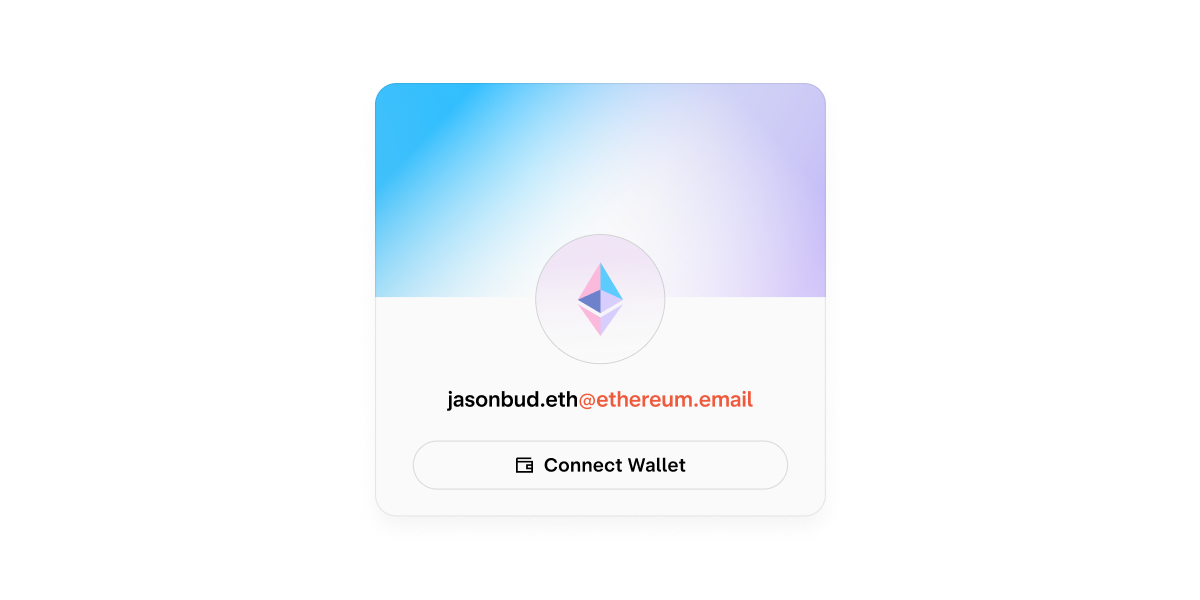
Today, every Skiff user will be able to send and receive email via their Ethereum addresses using the domain @ethereum.email - securely, privately, and for free.Below, we’ll walk through some basics on Ethereum (the network and cryptocurrency), the Ethereum Naming Service (ENS), how Skiff and Ethereum work together, and how you can start using your <wallet>@ethereum.email or <ENS>@ethereum.email today.
What’s Ethereum?
Ethereum was proposed in 2013 by Vitalik Buterin, a cryptocurrency researcher and programmer. Buterin had been involved in the development of bitcoin prior to that, and his work on Ethereum started shortly thereafter. Development was funded by an online crowdsale that took place between July and August 2014.The main Ethereum software client was released in July 2015, and the Ethereum network went live on 30 July 2015. When Ethereum launched, 11.9 million coins had been “premined” for all participants in the crowdsale. This accounts for about 13 percent of the total circulating supply.Mathematically, Ethereum uses the sec256k1 curve to generate public and private keys, which are subsequently used to generate Ethereum addresses. This curve was chosen because it provides a high degree of security while also being relatively efficient. The secp256k1 curve is a finite field curve over the integers modulo a prime p defined by the equation y2 = x3 + 7. The security of the secp256k1 curve comes from the fact that it is very difficult to solve the elliptic curve discrete logarithm problem (ECDLP) over this curve.Ethereum was initially described as a decentralized platform that would allow developers to build decentralized applications (dapps), which would be run on a decentralized network of computers (nodes). The main idea was to use blockchain technology to create a platform that would be more flexible than existing ones, such as bitcoin. Ethereum has been used in a wide variety of token sales, exchanges, NFT projects, and decentralized applications (dApps), raising over US$18 billion as of May 2018. Ethereum's smart contracts are based on different computer languages, which developers use to program their own functionalities.Ethereum x Skiff integrations
Skiff’s mission is to deliver a private, end-to-end encrypted, and truly user owned ecosystem for collaboration and communication. In the last year, we’ve been privileged to work with the best partners across the Ethereum community building technology to empower individuals to own their own data - and be producers, not products.Last December, we rolled out log in with MetaMask, enabling tens of millions of people with MetaMask wallets to sign in to Skiff and collaborate using their wallet address or ENS name. Since then, we’ve collaborated with Brave, Coinbase Wallet, the Ethereum Naming Service, Keplr Wallet, Unstoppable Domains, and Protocol Labs to bring the best technology in storage, wallets, identity, and security to Skiff.Today, you can use an Ethereum wallet to sign up for a Skiff account, gaining access to end-to-end encrypted email, collaboration, and file sharing. If you use an ENS name for your account (read more below), you’ll be able to collaborate and communicate using that identity as well.Your new @ethereum.email address
All of your verified wallet addresses - and their associated ENS names - can now send and receive mail using the domain @ethereum.email. For example, we at Skiff have registered the domain name skiff.eth using the address 0x0bc...ade6. Now, we’ll be able to send and receive email using this wallet address @ethereum.email, as well as skiff.eth@ethereum.email. You can also sign into Skiff’s mobile and desktop apps using this account to receive notifications and compose on the go.Note that all emails sent or received using an ethereum.email address use a verified wallet address that has signed an attestation. As a result, this provides trustworthy and transparent communications to the Ethereum community.Using your ENS@ethereum.email
The Ethereum Naming Service (ENS) is a decentralized naming system based on the Ethereumblockchain that can be used to resolve human-readable names to Ethereum addresses. ENS is designed to be censorship-resistant and to provide a more user-friendly experience than using traditional hexadecimal ETH addresses, which are long and difficult to remember. ENSdomain names are stored in the Ethereumblockchain and can be registered, updated, and transferred like any other Ethereum asset. More recently, ENS has launched platforms for auctioning and bidding on domain names, and OpenSea also allows users to sell and purchase ENS domains.You can also now send and receive email via your ENS name at the email address ethereum.email. For more information on setting up and using your ENS name on Skiff, read our blog here.Appendix: How does Ethereum work?
Ethereum is a decentralized network that runs smart contracts: applications that run exactly as programmed without any possibility of fraud or third party interference. Ethereum is a public blockchain-based distributed computing platform, featuring smart contract (scripting) functionality. It provides a decentralized virtual machine, the Ethereum Virtual Machine (EVM), which can execute scripts using an international network of public nodes. Ethereum also provides a cryptocurrency token called "ether", which can be transferred between accounts and used to compensate participant nodes for computations performed. "Gas", an internal transaction pricing mechanism, is used to mitigate spam and allocate resources on the network and is used to price smart contracts.Ethereum has since become one of the most popular blockchain platforms, with a wide range of decentralized apps built on top of it. These dapps cover a wide range of use cases, from financial applications and games to social networks and identity management. In the last year, DeFi (decentralized finance) has become particularly popular. Since the “Merge” event in September 2022, Ether is mined through a process called proof-of-stake, an energy-efficient way to commit resources to the Ethereum network and receive cryptocurrency as compensation.Related articles
Andrew MilichWhy you should use crypto wallets for your emailsHow Web3 and crypto wallets improve privacy, anonymity, identity portability, and encryption for email and communications.
Skiff TeamPrivacy Guide For Cryptocurrency UsersLearn about protecting your privacy in the crypto space.
Andrew MilichSOL names and Solana emailConnect your wallet and Solana Naming Service domains to send and receive at your Solana email - all completely privately.
Richard LiuKeplr Wallet: Web3 mail launchKeplr and Skiff announce a verified custom domain - keplr.xyz - for all Keplr wallet users to securely communicate.
Andrew MilichPrivate email's evolution: From Pretty Good Privacy to walletsHow private email has evolved from Pretty Good Privacy (PGP) encryption to built-in key exchange and crypto wallet integrations.
Andrew Milich10 tips for setting up an email accountSetting up a new email account can be a daunting proposition. Follow these tips for a painless migration and setup process.
Andrew MilichHow to pay in crypto?Cryptocurrencies are now used by hundreds of millions of people. How can you pay for Skiff in crypto?
Jason GinsbergNew Skiff tiersSkiff Pro and Skiff Business plans are now released. How can you use them to add custom domains, increase storage space, and onboard your team?